
What is a Corrosion Loop - PART 1 - CONCEPT

Corrosion loop is used to simplify inspection procedures in refining processes.

Corrosion loop is defined as a group of components with common materials, processes, and operating parameters. 
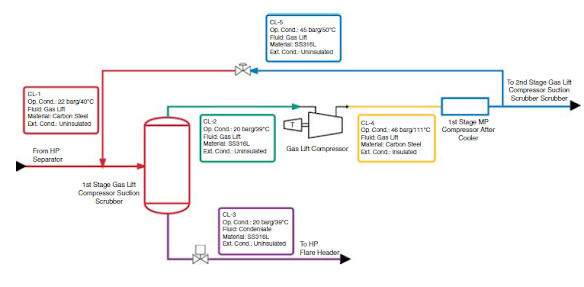

Source: Rachman, A. and Ratnayake, R.M.C. (2020), "Corrosion loop development of oil and gas piping system based on machine learning and group technology method", Journal of Quality in Maintenance Engineering, Vol. 26 No. 3, pp. 349-368. https://doi.org/10.1108/JQME-07-2018-0058


It is needed when the scenario has -

1. Complex process

2. Several variables such a materials of construction, process parameters, functions

3. Multiple damage mechanisms


WATCH THE VIDEO FOR A DETAILED EXPLANATION -


Click here for part 2!


😀Happy learning!😀

Comments

Popular posts from this blog

Corrosion risk planning - 1 - Lead acid battery

Corrosion is a quality, environment, and safety issue. Hence, it has to come under the cope of integrated management system audits However at the moment, it is more or less considered a quality issue. As such, the general tendency is to solve corrosion issues as they come. Especially in new inventions, the foresight to look for potential corrosion risk gets lost in the attempt to focus and highlight the amazing qualities of the said inventions. Hence, I have initiated this series, where I will take a component and point out the potential corrosion and damage risk areas.  Here goes the first one - lead acid battery cell. (Source:https://opentextbc.ca/chemistry/chapter/17-5-batteries-and-fuel-cells/)  Protective casing -  effect of temperature + electrolyte + contamination in electrolyte on the polymer crevice corrosion at fixtures mechanical damage during handling leading to voids for moisture ingress and oxygen/electrolyte leakage Positive terminal - corrosion of the mate...

Electrochemical testing - 2 - What is a reference electrode?

What is a reference electrode? A reference electrode is used as a scale to measure the potential of the working electrode. Reversible reactions Just as a scale is unchanging, the potential and chemical conditions of the reference electrode should also be unchanging. Thus, it is necessary that the reactions - oxidation and reduction -  occurring inside a reference electrode are reversible. This ensures constant chemistry. No polarization It also ensures that there is no net polarization as both reactions occur simultaneously at different points in the reference electrode. this keeps its potential constant. Thus, the potential of any working electrode connected to this reference electrode will be dependent only on the conditions of the working electrode. This makes it easier to note the changes happening in the working electrode. Check out the video for a detailed explanation Done? Click here for Part 1 and PART 3 ! NOW, Are you ready to test your corrosion knowledge?   Click h...

Need of 'CORROSION PLANNING'

Need for 'CORROSION PLANNING'  The importance of material selection cannot be stressed enough. With the equipment comes the material of the equipment, and every material is prone to corrosion in some way. For most fields such as defence, oil and gas, automotive, and marine, the qualification tests for the material selection begin and stop with the mechanical properties and composition. There is not even a mention of the possible corrosion phenomena for that particular material. This results in 'surprises' when there is a serious failure. Only after that are the corrosion investigations carried out and modifications done. However, by that time, it may be too late for some. Hence, it is necessary that the concerned personnel in the industries do not cut costs where corrosion is known to be an issue. What is Corrosion Planning? It is critical to begin a "CORROSION PLANNING" to ensure that the corrosion risks of every material that is qualified, and every componen...